Part 2 of a three part series on how to use homestays to jump-start a community-based entrepreneurial initiative. You can read Part 1 here.
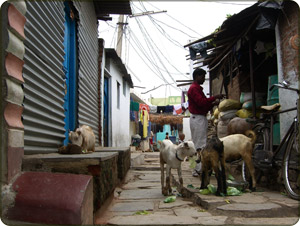
An alleyway in Indiramma Nagar
"Can I talk to you about something?" Muneer asked me during one of our afternoon walks around the city.
It's May of 2006, the fifth week our BoP initiative with the Solae Company, and I was in the middle of a weeklong homestay in Indiramma Nagar - a cluster of slums by the Hyderabad airport. Muneer was a young Muslim resident who I had been introduced to on my first visit to the neighborhood. Every day I looked forward to his arrival at my hosts Baba and Sultana's home, a little wood and corrugated steel structure by the airport wall. Not only did Muneer's 5 PM visit herald the abatement of the sweat-boiling heat, but his near perfect English gave me someone to talk to, not to mention someone to explain to me what I may have done wrong. I recognized his question as a prelude to such an explanation.
"Of course," I replied, stepping to the side of the alley as a rickshaw rumbled by.
"What happened last night?" he asked.
Ah yes, that . . . Ilias and his brother. I told Muneer about Sultana encouraging me to go with the two boys, walking with them through the alleys to another home, pushing aside the front curtain, and then seeing the sudden reaction of the women and children lying on the floor – surprise, fear, anger. I had no idea what was going on but I knew it was wrong. I had bowed a quick apology and dragged the boys out the door, walking hurriedly back to my hosts.
"That naughty boy," Muneer replied after I finished describing what happened, "I told Ilias you could not stay with him, but he decided to take you home any way. It seems he told Sultana that his family invited you, but they had not." He was looking at his feet, "We don't enter people's homes here without permission." Not where I come from either.
I sighed. Navigating the cultural trips here was tougher than almost anywhere I'd ever been. Sure I had studied before heading to India, but the Hyderabadi slum was a tumult of Hindu and Muslim cultures; I didn't even know what to say when. I'm not sure what I would have done without Muneer, or Srini, who worked for our local partner SIDUR and who would occasionally drop by. Culturally, I was like a child: I knew nothing and I trusted everyone. Muneer and Srini had already helped me avoid getting entangled with one local politician who wanted to "adopt" me... now I had gotten in trouble because two children had wanted to do the same
We walked quietly for several moments, but then Muneer turned and gave me a reassuring look. "Do not worry," he told me, "Here is what we can do..."










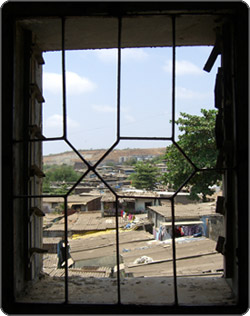 A window into the community