social enterprise

The Pioneer Launch of the Hoop Fund

The Pioneer Launch of the Hoop Fund

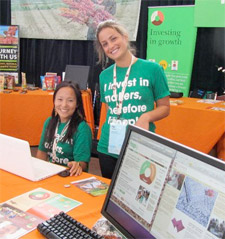
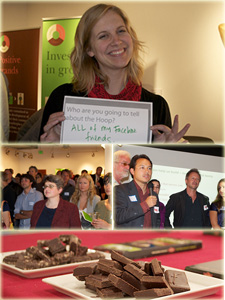
We had a phenomenal launch event for the Hoop Fund here in San Francisco this month, with more than a hundred of our close friends and colleagues coming together for the unveiling our website and to see what we're doing with two of our founding partners: Indigenous Designs and Alter Eco.

With Alter Eco chocolate, quinoa, and rice for people to enjoy, and designer apparel from Indigenous Design to try on, we presented five loan projects for the communities behind all the fantastic products on display: from a seed bank for the grower’s of Alter Eco’s red jasmine rice in Thailand, to a hand knitting loom for the weavers of Indigenous sweaters in Peru. All in all we raised $1200 in 0% loans that night for those projects and three others, and we’re working hard to get those projects fully funded.

The Hoop Fund

We were excited about how enthusiastically people responded to our vision of “invested consumption”: how we each can invest in the makers of great products in the developing world, and create our own personal stories about how we turned our consumption into something more meaningful. “I want to invest in chocolate!” one attendee told me after sampling several pieces of Alter Eco’s organic Dark Velvet chocolate.

To read more, head on over to the Hoop!

Investing in a better world, great chocolate too...

www.jointhehoop.com

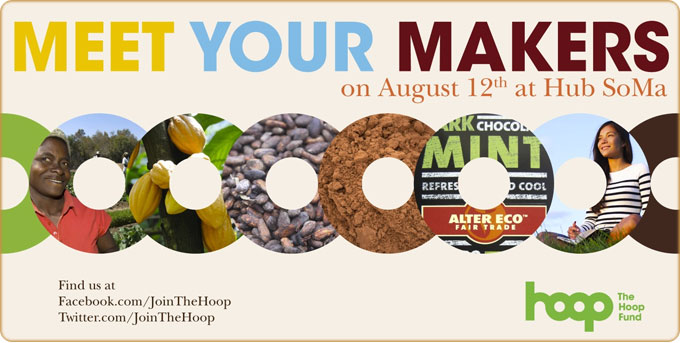
If you're in San Francisco this week, please join my colleagues and me for our friends & family unveiling of The Hoop Fund!

It will be a really fun evening of tasty treats and an opportunity to engage a great start-up project working to connect you to the makers of products you'll love, while also helping us get our first batch of projects started with our partners, Alter Eco and Indigenous Designs!

Please RSVP

All the best,
Patrick

  • When: Thursday, August 12, 6:30-8:30
  • Where: The Hub in SoMa, 901 Mission St, San Francisco
  • RSVP: Here or on Facebook
  • Share on Twitter: #theHoop and find us @Jointhehoop

Homestays Part 3 - During and After

Part 3 of a three part series on how to use homestays to jump-start a community-based entrepreneurial initiative. Also check out Part 1 and Part 2.

A window into the communityA window into the community

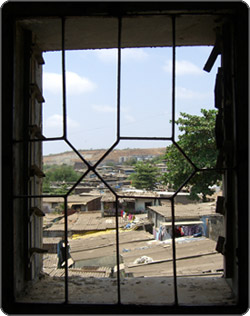
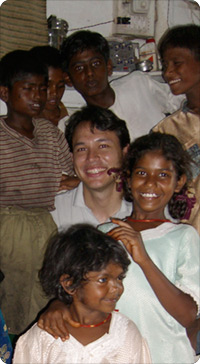
May 6th, 2006, the third day of my homestay in the Sri Lanka colony of the Indiramma Nagar slum cluster, next to the airport in Hyderabad, India. The mercury was pushing 46 degrees Celsius. No hint of the coming monsoon.

"Soja," my host Sultana ordered me. I didn't argue, the combination of the Indian summer and all the rice and spice I had just eaten made taking a nap look like the most sensible option. A well-intentioned ceiling fan was forcing hot air down onto me, evaporating the sweat below my skin and drying out the insides of my nose. I felt like I was drinking gallons of water yet never had to go to the bathroom.

Before starting my homestay with Sheik Baba and Sultana, I had a host of plans to learn local skills and reach out to people in the slums, but the sheer heat of the day had made me scale back my aspirations. I was still managing to get out and meet people in the community, but had to retreat to shadier spots whenever the sun was high in the sky, which was often. Making friends while doing something active like hauling trash, as I had in Nairobi, didn't seem like much of an option here.

In the meanwhile, my attempts to help out around the house had met with mixed success. For example, when the local taps turned on in the morning I had gone out to help Sultana haul water, but I almost botched the job when some joking neighbors tried to get me to pour the water down a sewage trench instead of into the family's water tank. Still my presence seemed to have bumped up Sultana's position in the subtle hierarchy around the public water taps, so maybe I was helping after all.

I lay down to rest as the kids settled in to watch a show on the family's TV: the electricity could be fickle, but they had access to lots of channels. In an hour my new friend Muneer was coming around to introduce me to someone who ran a small ice cream business, and then later we were going to his cousin's wedding. Along the way we would stop and visit some more local businesses and meet some of the rickshaw drivers.

Things hadn't turned out exactly like I had expected, but I guess that was to be expected too...

Deeper, better - building community & economy

In the face of energy shortage, of global warming, and of the vague but growing sense that we are not as alive and connected as we want to be, I think we’ve started to grope for what might come next. And just in time.
– Bill McKibben, “Deep Economy"

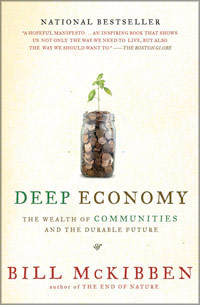
Fittingly enough, I picked up Deep Economy at a community book sale for a local library in Ithaca, NY. The book sale had an impressive selection and a "chat with your neighbor" kind of energy, and it wasn't long before I ended up in the business section trading recommendations with a couple of management professors from Cornell University.

“That’s a great book,” commented Jim, who researches leadership and ethics at Cornell. An older gentleman browsing nearby turned to join the conversation, shaking his head when he saw the cover, “Bill McKibben is a good writer. But he doesn’t know much about how economics work.”

Though I have never met McKibben, I don’t think he would have minded the comment much. McKibben’s 2007 bestseller isn't a treatise on how economics works, but instead explores a much more critical question: do our economics work for us? McKibben's answer is no, or more accurately, that our current economic models no longer serve us as well as they should, especially the driving paradigm that more is a good proxy for better.

Homestays Part 2 - Setup and Preparation

Part 2 of a three part series on how to use homestays to jump-start a community-based entrepreneurial initiative. You can read Part 1 here.
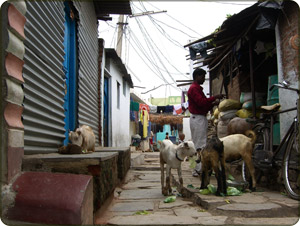
An alleyway in Indiramma NagarAn alleyway in Indiramma Nagar

"Can I talk to you about something?" Muneer asked me during one of our afternoon walks around the city.

It's May of 2006, the fifth week our BoP initiative with the Solae Company, and I was in the middle of a weeklong homestay in Indiramma Nagar - a cluster of slums by the Hyderabad airport. Muneer was a young Muslim resident who I had been introduced to on my first visit to the neighborhood. Every day I looked forward to his arrival at my hosts Baba and Sultana's home, a little wood and corrugated steel structure by the airport wall. Not only did Muneer's 5 PM visit herald the abatement of the sweat-boiling heat, but his near perfect English gave me someone to talk to, not to mention someone to explain to me what I may have done wrong. I recognized his question as a prelude to such an explanation.

"Of course," I replied, stepping to the side of the alley as a rickshaw rumbled by.

"What happened last night?" he asked.

Ah yes, that . . . Ilias and his brother. I told Muneer about Sultana encouraging me to go with the two boys, walking with them through the alleys to another home, pushing aside the front curtain, and then seeing the sudden reaction of the women and children lying on the floor – surprise, fear, anger. I had no idea what was going on but I knew it was wrong. I had bowed a quick apology and dragged the boys out the door, walking hurriedly back to my hosts.

"That naughty boy," Muneer replied after I finished describing what happened, "I told Ilias you could not stay with him, but he decided to take you home any way. It seems he told Sultana that his family invited you, but they had not." He was looking at his feet, "We don't enter people's homes here without permission." Not where I come from either.

I sighed. Navigating the cultural trips here was tougher than almost anywhere I'd ever been. Sure I had studied before heading to India, but the Hyderabadi slum was a tumult of Hindu and Muslim cultures; I didn't even know what to say when. I'm not sure what I would have done without Muneer, or Srini, who worked for our local partner SIDUR and who would occasionally drop by. Culturally, I was like a child: I knew nothing and I trusted everyone. Muneer and Srini had already helped me avoid getting entangled with one local politician who wanted to "adopt" me... now I had gotten in trouble because two children had wanted to do the same

We walked quietly for several moments, but then Muneer turned and gave me a reassuring look. "Do not worry," he told me, "Here is what we can do..."

Homestays Part 1 - Objectives and Challenges

Homestays are a powerful tool to begin a community-based entrepreneurial effort, but they need to be approached with tremendous humility and planning.

Homestay in AP, India

In 2006, I spent a week living with a family in the Indiramma Nagar slum cluster of the city of Hyderabad. Sheik Baba and Sultana – along with their four children, mother, and niece – hosted me in their small, single room home by the airport wall. Baba and Sultana were perfect hosts. They opened their small home to me and I greatly enjoyed the time I spent with them: despite the extreme heat of the Indian summer (115 °F) and our limited means of communication.

Weeks later while working with our business partners (a group of local women in the slum), a colleague brought up the fact that I had stayed with Baba and Sultana. There was a stir of comments among the women.

"What is it?" I asked.

"The family is very poor,” my colleague translated, “they are surprised that you could stay with them.”

They were particularly surprised that I didn't mind eating and drinking with the family: Westerners aren't normally known for very strong stomachs. To be honest, I had been a bit concerned when Sultana handed me that first cup of water, but it hadn't really seemed practical to refuse. Did I mention how hot it was? After the first cup went down though, and stayed down, I accepted plenty more.

In fact, besides my almost comical trait of not being able to eat without crying – no matter how little spice Sultana tried to cook with – everything had gone great. I had made friends and experienced a side of the community that few outsiders ever get to see. Plus, most of these women who we were building a new business with had met us as a result our team's homestays. Introductions had led to introductions, but it had all started there in the community.

Quite a productive week.

Like riding a bike - 5 tips to breakthrough to business

Kid riding a bike
Kick off the training wheels

When I was a kid learning to ride a bike, I was convinced that I first needed to figure out how to balance. You know... without moving. Fortunately, my mom saw my predicament and one day just pushed me and my bike off the driveway. To my surprise I didn't fall, and pretty quickly I was cruising around the neighborhood on my own. The lesson?

It's hard to get stability without forward momentum.

Similarly, I often notice a key balancing moment when the enterprises I work with go from being just promising ideas to something tangible. In India - for a new venture that promoted soy protein and nutrition - that moment came when our local team went from just talking about soy protein to actually cooking with it in their neighbors' kitchens… hundreds of them. Those experiences, and what it took to make them happen, changed everything: building an initial set of capabilities, credibility, and consumer relationships that actually pulled the business forward.

It's understandable that with so many details to manage in launching a business, you might instead get stuck in my poverbial driveway. But the key is to concentrate less on what your business will look like once it gets moving, and just figure out what you need to do to get it moving. Focus your efforts on an attainable breakthrough that will change everything.

The caring conundrum – beyond badges for social enterprise

save the earthGreen not working? Try chocolate...
source:cafepress

At a loss for how to explain what I do for a living, my sister once described my work as “something to do with pyramid schemes and poor people.” I can laugh at it now (the base of the pyramid is an awful phrase for a number of reasons), but the incident highlights how contradictory most people find the combination of capitalism and doing good for the world.

Even when familiar with enterprises that use “capitalism for good”, most people generally call to mind a class of companies that fill a small, though often profitable, niche of eco- or socially-conscious consumers. By in large, growth in those markets is defined by how much you can make people care (about the planet, about people, about pandas).

Green badge: Do Good, Buy Now!

There’s another class of companies, however, who may use green means, but who don’t rely on consumer sentiment about society or the environment to sell their stuff. Among these are many of the companies I have worked with in recent years, where the name of the game has been catalyzing massive new markets, primarily in the so-called base of the economic pyramid. While they used inclusive means to serve poor communities, these companies’ goals were those of growth-seeking, profit-oriented enterprises.

Syndicate content